The CAGED System Explained, Shown on the Neck
If you can play open chords but the rest of the neck still feels like unmarked territory, the CAGED system is the map you are missing. It connects the shapes you already know to every position further up the neck. Once it clicks, you can play any major chord anywhere, and your scales and arpeggios start to line up with those shapes too. If the notes on the neck are still fuzzy, start by learning the fretboard first.
This is an intermediate topic. If open chords are still new, come back once C, A, G, E, and D feel comfortable. When they do, CAGED is the thing that opens the whole neck up.
What CAGED actually means
CAGED is just five letters: C, A, G, E, D. Those are five open chord shapes you probably already know. The insight is that each shape can slide up the neck, with a barre in place of the nut, to play the same chord in a new spot. Move an open C shape up the neck and it is still a C-type shape, just voicing a higher chord.
Put all five shapes together and they tile across the entire neck without gaps. For any chord, there are exactly five CAGED positions, and they always appear in the same order.
The five shapes tile the neck
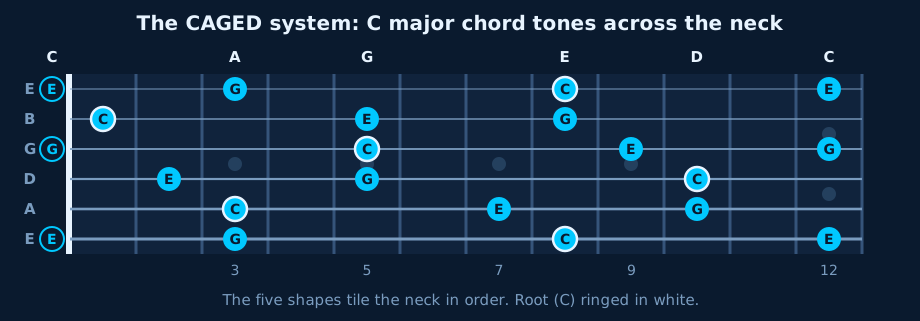
The diagram above shows C major across the neck as chord tones, with letters marking where each of the five shapes sits. Notice the order: C, then A, then G, then E, then D, then back to C an octave higher.
A few things to see:
- The shapes always run C to A to G to E to D, then repeat. That order never changes, in any key.
- Each shape overlaps with the next. The top of one is the bottom of the one above it, which is how they connect end to end.
- The root note (C here, highlighted) sits in a known place inside each shape. That root is your anchor for finding the shape anywhere.
For C major, the C shape sits at the open position, the A shape around the third fret, the G shape around the fifth, the E shape around the eighth, and the D shape around the tenth, before the C shape returns at the twelfth. Change the key and the same five shapes slide to new frets, still in that same order. Past the twelfth fret the cycle simply starts over, and CAGED past the 12th fret shows where each shape lands in that second octave.
Why the G-to-B string looks a little off
If you map these shapes yourself, watch the second string. The gap between the third string (G) and the second string (B) is smaller than the gap between the other strings, so shapes shift by a fret as they cross onto the B and high E strings. This is where a lot of players, and a lot of apps, get the shapes subtly wrong. Getting it right is what makes the shapes actually connect.
How CAGED ties your chords, scales, and arpeggios together
The real payoff of CAGED is not just moving chords around. Because each shape is a chord shape, the chord tones sit inside it, and the scale that fits the chord wraps around those same tones. Learn the E shape of a C chord at the eighth fret and you have also found the home for the C major arpeggio and the C major scale in that position. Chord, arpeggio, and scale all live in the same neighborhood, marked by the same root. That is why players who know CAGED can find all three in one spot instead of hunting for separate shapes.
The same five shapes in another key
Change the key and the shapes simply slide to a new home, still in the same C-A-G-E-D cycle. In the key of G, the open position is the G shape. Moving up the neck the cycle continues: the E shape around the third fret, the D shape at the fifth, the C shape at the seventh, and the A shape at the tenth, before the G shape returns at the twelfth. Different frets, same five shapes, same order. Once you internalize the cycle, you can drop into any key and know which shape comes next without thinking about it.
How to practice CAGED without getting lost
- Learn one shape's root first. Pick the E shape and know exactly where its root sits on the low E string. That one anchor lets you move it to any key.
- Add the neighbors. Once the E shape feels solid, learn the shapes on either side and how they overlap.
- Say the chord you are playing. Moving the A shape to the eighth fret is not just a shape, it is a specific chord. Naming it keeps the system musical.
- Connect, do not memorize five boxes. The point of CAGED is that the shapes join up. Practice sliding from one into the next along the neck.
See the shapes connect, do not just read about them
CAGED clicks when you can watch the five shapes light up along the neck and see how they overlap, rather than picturing five separate diagrams. That is what the Sustain Six fretboard explorer shows: pick a chord and see its CAGED positions laid out across an interactive neck, in order, with real guitar sound. It is free to try, right in your browser.
Frequently Asked Questions
- What does CAGED stand for?
- It is the five open chord shapes C, A, G, E, and D. Those five shapes tile across the whole neck, so any chord can be played in five positions.
- Is the CAGED system worth learning?
- Yes, once you know your open chords. It connects the shapes you already play to the rest of the neck and ties your chords, scales, and arpeggios to the same positions.
- Is CAGED good for beginners?
- It is an intermediate topic. Learn your open chords first, then use CAGED to understand how barre chords and scale positions relate across the neck.