
How to Learn the Guitar Fretboard (Without Rote Memorization)
Most players learn a handful of chord shapes, a pentatonic box, and then hit a wall. The wall is almost always the same thing: the fretboard is still a mystery. You know shapes, but you do not know notes, so you cannot move anything anywhere on purpose.
The good news is that you do not need to memorize 138 fret positions one by one. The fretboard has a structure, and if you learn the structure, most of the notes come along for free. Here is the system.
Start with the low E and A strings
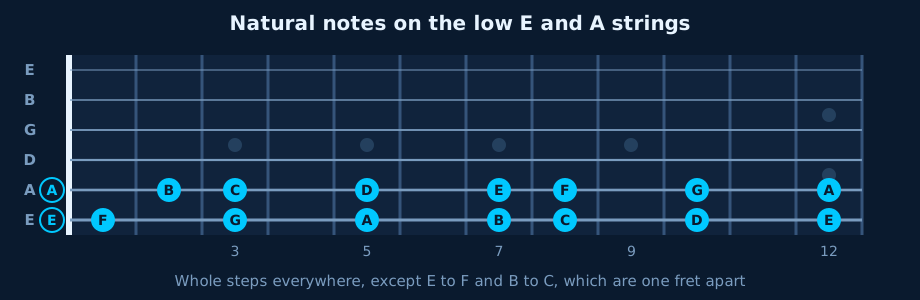
Almost everything on guitar is anchored to the two lowest strings. Barre chords, power chords, and most scale positions are named after their root note on the low E or A string. Learn the natural notes (no sharps or flats) on just those two strings first:
- Low E string: F at fret 1, G at 3, A at 5, B at 7, C at 8, D at 10, E at 12
- A string: B at fret 2, C at 3, D at 5, E at 7, F at 8, G at 10, A at 12
Notice the pattern in the numbers: from any natural note, you move two frets to the next one, except for the two half steps in the musical alphabet. E to F and B to C are only one fret apart. That single rule generates both lists above.
Use octave shapes to multiply what you know
Once the low E and A strings are solid, you can find the same note an octave higher with one simple shape: go up two strings and up two frets. A note at fret 5 on the low E string (A) reappears at fret 7 on the D string. A note at fret 3 on the A string (C) reappears at fret 5 on the G string.
That one shape instantly maps the D and G strings from the two strings you already know. Two strings of real knowledge just became four.
Watch out for the B string
Standard tuning is not perfectly even. Four of the five string pairs are tuned a fourth apart, but the gap between the G and B strings is a major third, one fret smaller. Any shape that crosses from the D or G string onto the B or high E string has to shift up one extra fret.
So the octave rule becomes: two strings up and two frets up, unless the shape crosses the B string, in which case it is two strings up and three frets up. A note at fret 5 on the D string (G) lands at fret 8 on the B string, not fret 7. This is the single most common source of wrong notes when players start moving shapes around, so drill it early.
Use the fret markers as landmarks
The dots on your neck are not decoration. Frets 3, 5, 7, 9, and 12 are the landmarks that make finding notes fast:
- Fret 5 on any string is the same pitch as the next open string, except on the G string, where the match is at fret 4. This is the classic tuning check, and it is also a map.
- Fret 12 is always the same note as the open string, one octave up. The whole fretboard repeats from there.
- On the low E string, the marker frets 3, 5, and 7 are G, A, and B. On the A string, the same frets are C, D, and E.
Between the markers and the half-step rule, you can now derive any natural note on any string in a second or two. Sharps and flats are just the frets in between.
A five-minute daily routine
Knowing the system is not the same as owning it. Here is a routine that takes five minutes a day and pays off within a few weeks:
- Pick one note name, for example G.
- Say it out loud and play it on every string, low E to high E, using the octave shapes and landmarks to find each one.
- Do the same note again from high E back down to low E.
- Tomorrow, pick the next note in the cycle of fourths: G, then C, then F, and so on.
The goal is recall speed, not perfection. When you can name and play any natural note on any string in under two seconds, chord shapes, scales, and improvisation all get dramatically easier, because you finally know where you are.
Where to go next
Once the notes click, everything else on the neck is built on them. These go in a sensible order:
- caged system guitar, five chord shapes that organize the whole neck.
- CAGED past the 12th fret, what happens when those five shapes start over at the octave.
- guitar scales across the neck, one scale as a set of notes instead of one shape.
- major scale guitar positions, the positions joined into one connected pattern.
- pentatonic box guitar, how to get out of the box at the fifth fret.
- guitar arpeggio shapes, the chord tones that always sound good.
- circle of fifths guitar, which chords belong together and where a song goes next.
- guitar fretboard diagram, how to read any chart you meet.
- how to use a metronome for guitar, why slow practice is harder than fast and how to use the click.
- how to read guitar chord progressions, the numbers behind the chords in a song.
- guitar chord tones, why a note from the right scale can still sound wrong.
Practice it on a real fretboard
Reading about the fretboard only gets you so far. The fastest way to internalize the map is to see it and hear it while you practice. The Sustain Six fretboard explorer lights up every position of any note, scale, or chord on an interactive neck, with real guitar sound, so you can check yourself instantly. It is free to try, right in your browser.
Frequently Asked Questions
- How long does it take to learn the fretboard?
- With a few minutes of focused practice a day, most players can name any natural note in a few weeks. The key is learning the structure, not memorizing every position one by one.
- What is the easiest way to memorize guitar notes?
- Start with the natural notes on the low E and A strings, then use octave shapes to map the rest. The two-frets-up, two-strings-over octave shape does most of the work.
- Why is the B string different?
- The gap between the G and B strings is a major third, one fret smaller than the others, so any shape crossing onto the B or high E string shifts up one fret.