
The Circle of Fifths for Guitar, in Plain English
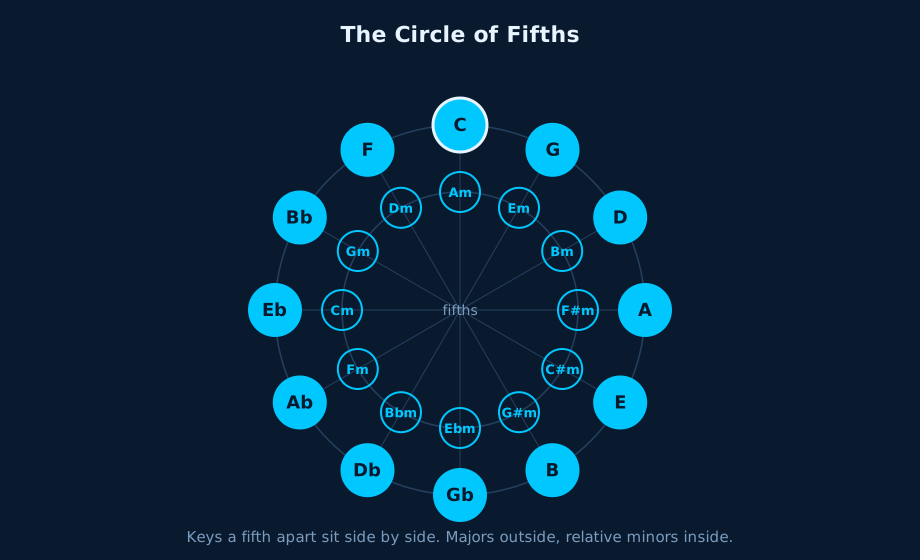
The circle of fifths looks like a clock that got a music degree, and most explanations make it worse. Stripped down, it is just a map of how the twelve keys relate to each other. For a guitar player, it answers three everyday questions: which chords belong together, where a song is likely to go next, and how to move an idea into a new key. Here is the plain-English version. It lands faster if you can already learn the guitar fretboard well enough to find any root note quickly.
What the circle actually shows
Start at the top with C and move clockwise. Each step up is a fifth: C, G, D, A, E, and so on. Move counterclockwise instead and each step is a fourth: C, F, Bb, Eb. That is the whole trick behind the name. Keys that sit next to each other on the wheel are closely related and share almost all of their notes, which is why they sound good together.
Reading the wheel
The diagram above puts the major keys on the outside and each one's relative minor on the inside.
- Clockwise is fifths, counterclockwise is fourths. Neighbors are one step apart and share the most notes.
- Relative minors sit inside. C major and A minor use the exact same notes, so A minor sits just inside C. Every major key has a minor twin this way.
- Sharps and flats build up as you go. Moving clockwise from C adds one sharp at a time. Moving counterclockwise adds one flat at a time. C, at the top, has none.
Why a guitarist should care
You do not need to memorize the wheel to use it. Three practical payoffs:
- Chords that belong together. The chords in a key are clustered on the circle. In the key of G, the neighbors G, C, and D are your three main chords, and the relative minor Em is right there too. That is most of a campfire song.
- Where progressions move. A huge amount of music moves counterclockwise, one step at a time, pulling toward home. Once you feel that pull, you can often guess the next chord before you hear it.
- Changing keys. If a song is too high to sing, drop it a whole step or two. The circle shows how many sharps or flats the new key has, and neighboring keys share all but one note, so a move to a neighbor sounds smooth.
The fastest way to make it stick
Pick a key, find it on the wheel, and play its neighbor on each side plus the relative minor. In G that is C, D, and Em. Strum between them and listen to how naturally they lean on each other. Do that in three different keys and the circle stops being a diagram and starts being something your hands already know.
Seeing the notes light up as you move around the keys makes the relationships obvious fast. The Sustain Six circle of fifths and fretboard tools show the notes of any key on the neck and play them back with real guitar tone, so the connections click by ear as well as by eye. It is free to try, right in your browser.