
Guitar Chord Tones, and Why Your Solos Land on the Wrong Note
You learn the scale, you check that every note in your solo comes from it, and a phrase still ends sounding wrong. That's frustrating, because the scale was supposed to be the safe list. You're right that nothing you played was outside the key. The trouble is where one of those notes landed, and guitar chord tones are how you control that.
If arpeggios are new to you, guitar arpeggios covers what chord tones are and the shapes they make. This post is about why they decide whether a solo sounds finished.
What chord tones are
Chord tones are the notes a chord is built from. A C major chord is C, E and G, which are its 1, 3 and 5. Seventh chords add a fourth note.
| Chord | Formula | In C |
|---|---|---|
| Major | 1 3 5 | C E G |
| Minor | 1 b3 5 | C Eb G |
| Major 7th | 1 3 5 7 | C E G B |
| Dominant 7th | 1 3 5 b7 | C E G Bb |
| Minor 7th | 1 b3 5 b7 | C Eb G Bb |
The scale gives you seven notes. Only three or four of them belong to the chord playing under you right now.
Every scale note has a different job
Take a C major chord in the key of C major and go through the scale one note at a time.
- C, E and G are the chord tones. End a phrase on one and it sounds settled.
- D and A are the 9 and the 13. They add color, and plenty of players hold them on purpose.
- B is the major 7. Held over C, it gives you the sound of a Cmaj7 chord.
- F is the 11, and it's the note most likely to sound like a mistake.
Why F rubs against the chord
F sits a half step above E, and E is the chord's 3. Hold F on a strong beat over a C chord and it rubs against that E. Your ear hears it leaning down toward E and waiting for it to arrive. Play the same F on the way through, moving to E, and it sounds fine. It's the same note, just not held long enough to clash.
Teachers don't all agree on how strict to be about this. Chord-scale teaching calls the 11 an avoid note over a major seventh chord. Most jazz teaching only avoids holding it on a strong beat. Blues and rock players hang on that note over a major chord all the time, which is the sus4 sound. They also add a flat 3 that isn't in the scale at all.
The key alone won't tell you, either. Put the same C chord in the key of G, where it's the IV chord. Now F# is in the key and F isn't. The chord tones are still C, E and G, but the notes around them have new jobs.
How to use guitar chord tones in a solo
- Know the chord under you. The key tells you which notes are available. The chord tells you which ones will sound settled.
- Aim strong beats and phrase endings at a chord tone. The 3 is the most telling one, because it's the note that says major or minor.
- Use the other scale notes to travel. They connect one chord tone to the next.
- When a note sounds wrong, check two things. Is it a half step above a chord tone, and is it sitting on a strong beat? Move it down a fret onto the chord tone, or keep moving through it.
Find the 3 on the neck
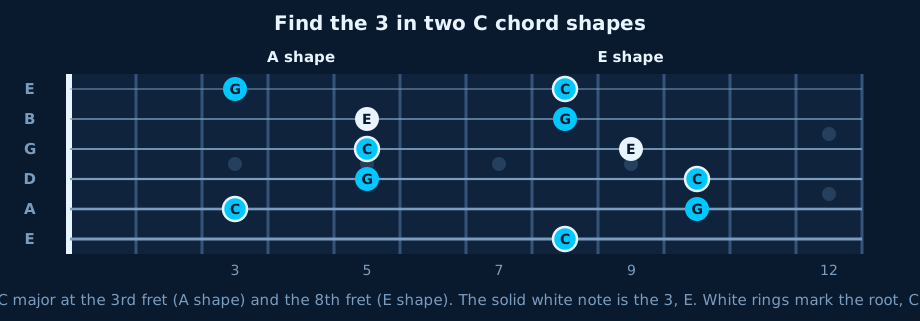
The 3 is worth finding first in every shape you know. In the E-shape C chord at the 8th fret, played 8-10-10-9-8-8, the notes are C G C E G C, and the 3 is on the G string at the 9th fret. In the A-shape C chord at the 3rd fret, played x-3-5-5-5-3, the notes are C G C E G, and the 3 is on the B string at the 5th fret.
When you move a shape across strings, watch the B string. Every pair of neighboring strings is tuned a fourth apart except G to B, which is a major third. So anything that crosses onto the B or high E string sits one fret higher than the pattern on the lower strings would suggest.
See every note's job
Chord tones get easier once you stop working out numbers in your head and can simply read them. The Sustain Six fretboard has a Note Display setting for Degrees, which labels every note by its number from the root you picked. On a C 7th chord, C shows as 1, E as 3, G as 5 and Bb as b7. On the Scales tab, a Triads overlay hides every scale note except the root, third and fifth of the scale's home chord. Turning it off brings back the notes that travel between them. It's free to start, and you don't need an account.
Frequently Asked Questions
- Which chord tone matters most in a solo?
- The third. It tells your ear whether the chord is major or minor, so landing on it ties a phrase to the chord. On C major that's E, the 3. On C minor it's Eb, the b3. On a seventh chord the seventh comes a close second. Cmaj7 has the 7, which is B. C7 has the b7, which is Bb.
- What is an avoid note?
- It's a scale note that tends to clash when you hold it over a chord, usually because it sits a half step above a chord tone. Over a C major chord in the key of C, that note is F, a half step above E. Teachers differ on how strictly to avoid it.
- Should I only play chord tones when I solo?
- No. A solo made only of chord tones sounds like an arpeggio exercise. Most players aim strong beats and phrase endings at chord tones and use the other scale notes to move between them.