
Guitar Arpeggios: Chord Tones You Can See
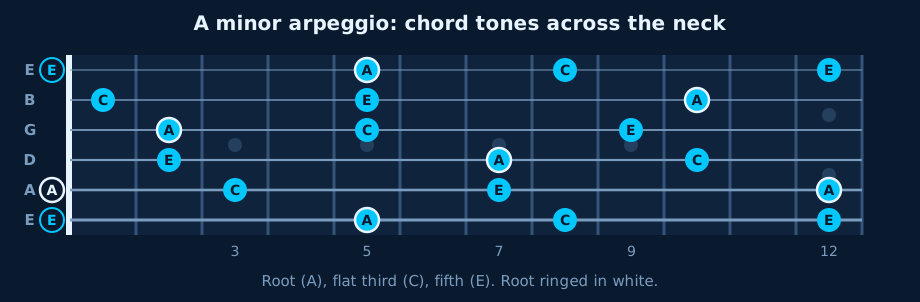
An arpeggio is not some advanced trick. It is just a chord played one note at a time. If you can name the notes in a chord, you already know the arpeggio. What makes arpeggios powerful for a guitar player is that they show you the exact notes that will always sound good over that chord, anywhere on the neck. Finding them anywhere is the part that depends on being able to learn the guitar fretboard rather than one shape.
Arpeggio versus scale
A scale gives you all seven notes of a key. An arpeggio gives you only the chord tones, usually three of them: the root, the third, and the fifth. Those are the notes at the heart of the chord, so landing on them in a solo sounds intentional and strong, while the other scale notes are passing color.
That is the difference in one sentence: scales are the whole neighborhood, arpeggios are the houses you actually want to land on.
Reading the shape
The diagram above shows an A minor arpeggio across the neck: A (the root), C (the flat third that makes it minor), and E (the fifth). The root is ringed so you always know home base.
A few things to notice compared to a scale:
- Arpeggios skip notes. Because you are using only three of the seven notes, the gaps between notes are wider and there is often only one or two per string. Expect bigger jumps than a scale pattern.
- The shape repeats. Like everything on the neck, the pattern comes back an octave higher at the twelfth fret.
- The G-to-B string still shifts. As the shape crosses onto the B and high E strings, it moves up a fret, because those two strings are tuned a little closer together than the rest. This is where arpeggio shapes are most often drawn wrong, so trust the diagram over your assumptions.
How to actually use it
- Play the chord, then the arpeggio. Strum an Am, then pick through A, C, and E in the shape above. Hear how the arpeggio is just that chord unpacked.
- Target chord tones in a solo. Over an Am chord, aim to land on A, C, or E on the strong beats. Fill the space between with scale notes. Your lines will suddenly sound like they belong. Guitar chord tones explains why a note from the right scale can still clash with the chord under it.
- Follow the changes. When the chord changes, switch to that chord's arpeggio. Outlining each chord's tones as it goes by is the core of melodic soloing.
Arpeggios click when you can see the chord tones light up across the whole neck and hear them played back in time. The Sustain Six fretboard explorer shows any arpeggio with correct multi-octave shapes and real guitar tone, so your eyes and ear learn the same map together. It is free to try, right in your browser.