
Guitar Scales Across the Neck, Not Just the Box
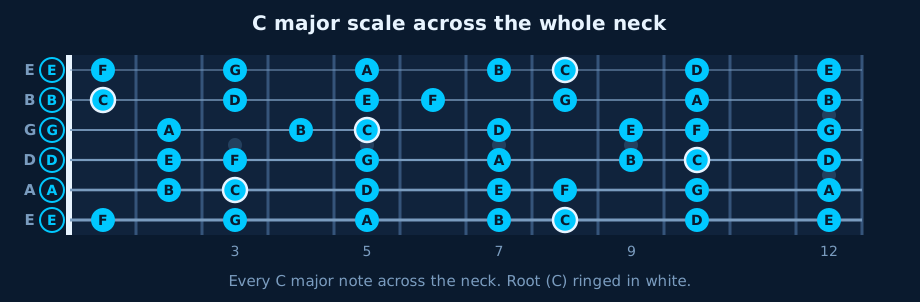
Most players learn one scale shape, usually a pentatonic box around the fifth fret, and then live there forever. It works, but it boxes you in. Every solo starts and ends in the same spot, and the rest of the neck sits unused. The fix is to stop seeing a scale as one shape and start seeing it as a single set of notes that covers the entire fretboard. That switch is much easier once you learn the guitar fretboard by note name instead of by picture.
One scale, many positions
A scale is not a shape. It is a group of notes. The C major scale is C, D, E, F, G, A, B, and those seven notes repeat all over the neck. Any shape you have learned is just one window onto that larger pattern. The box is not wrong, it is simply incomplete.
When you see the whole set of notes at once, the shapes you already know stop being separate boxes and become connected regions of one continuous map.
The whole neck, one scale
Here is the C major scale across the entire neck. Every note in the scale is shown, with the root C highlighted so you can see it repeat.
What to notice:
- The pattern repeats at the twelfth fret. Whatever you learn in the first twelve frets happens again above it.
- Your familiar box is in there. Find the fifth-fret region and you will see the shape you already know, now connected to everything around it.
- The notes flow from one string to the next. There are no gaps, just one region handing off to the next along the neck.
The G-to-B string shift
As the scale crosses from the third string (G) to the second string (B), the notes step over by a fret compared to the other strings. This is because that pair of strings is tuned a little closer together than the rest. It is a small thing, but it is exactly where scale shapes get drawn wrong. Once you expect that shift, the upper strings stop surprising you.
A method to connect the positions
- Start from what you know. Take your current box and find its root notes. Those roots are your landmarks everywhere else.
- Move up one region at a time. From the top of your box, find where the next notes continue higher up the neck. Learn the overlap between the two, not two separate shapes.
- Follow the roots. Practice finding every root of the scale across the neck. The roots are the skeleton that the rest of the shape hangs on.
- Use three notes per string for fluency. Laying three scale notes on each string gives an even, repeatable pattern that is great for smooth runs and connecting positions. It is a natural next step once the map makes sense. This works for full scales, not five-note pentatonics.
Learn it by seeing and hearing it
A scale across the neck is hard to grasp from a static diagram alone. It clicks when you can pick a root, watch the whole scale light up across every string, and hear it played back so your ear connects the positions your eyes are seeing. That is what Sustain Six does: choose any scale and see it mapped across the full neck with real guitar tone, so the box finally opens into the whole fretboard.