
How to Read a Guitar Fretboard Diagram
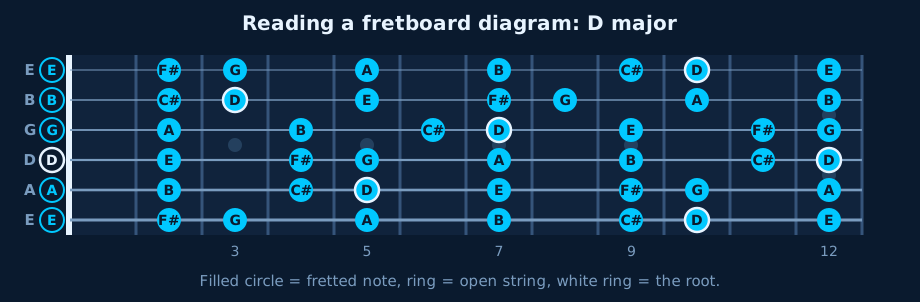
Fretboard diagrams pack a lot of information into a small picture, and once you can read one, you can read every scale, chord, and arpeggio chart you will ever meet. Here is how to decode the one above, which shows the D major scale. A diagram tells you where to put your fingers; to know what you are playing, learn the guitar fretboard alongside it.
The layout
A horizontal fretboard diagram is a picture of your guitar as if it were lying flat, looking down at the neck.
- The horizontal lines are the strings. In these diagrams the thinnest, highest string (high E) is at the top and the thickest, lowest string (low E) is at the bottom, labeled E, B, G, D, A, E from top to bottom. The strings even thicken toward the bottom to match the real thing.
- The vertical lines are the frets. The thick bar on the far left is the nut, the top of the neck. Each space to the right of it is the next fret.
- The numbers underneath are fret markers. They line up with the dots on your real neck at frets 3, 5, 7, 9, and 12, so you can find your place quickly.
The dots mean notes
Each circle marks a note you would play.
- A filled circle is a fretted note. Press that string at that fret.
- A ring, sitting in the column left of the nut, is an open-string note. Play that string without pressing any fret.
- A circle with a white ring around it is the root. The root is home base, the note the scale or chord is named after. Spotting the root first orients everything else.
Put it together
Look at the diagram and read it one string at a time. Start on the low E string at the bottom, find each marked note left to right, then move up to the A string, and so on. On the D major diagram, the ringed D notes are your landmarks, and everything else is a step in the scale around them.
That is the whole language. Strings, frets, the nut, filled for fretted, ring for open, white ring for the root. Every diagram on this site uses the same rules, so once this clicks, they all do.
The fastest way to make a diagram real is to see it on an interactive neck and hear each note. The Sustain Six fretboard explorer lets you tap any note, scale, or chord and hear it played back with real guitar tone, so the diagram turns into sound under your fingers. It is free to try, right in your browser.