
How to Use a Metronome for Guitar, and Why Slower Is Harder
You turn the metronome on, play along for thirty seconds, and turn it off again because it feels like being nagged. Most players do this, decide the metronome is not for them, and go back to practicing without one, when the real issue is that nobody explains how to use a metronome for guitar in a way that produces an actual answer. It just sits there ticking while you play roughly in time, and you learn nothing from it.
A metronome is a measuring instrument, not a backing track, and the only useful question it answers is whether your note landed where you thought it did.
Why slow tempos are harder than fast ones
Set something you can already play to 120 beats per minute and it will probably sound fine. Set the same thing to 50 and it falls apart. That surprises people, because slow is supposed to be the easy end.
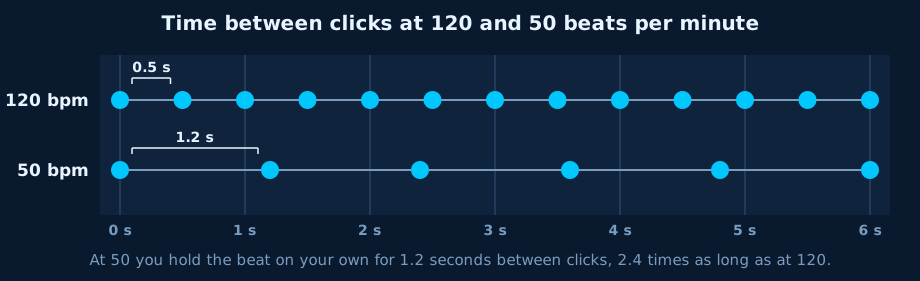
Here is why. At 120 beats per minute a click arrives every half second. At 50 it arrives every 1.2 seconds, a gap 2.4 times as long. At 120 you're never more than a quarter second from a reference point, so the click keeps hauling you back onto the beat before you've drifted anywhere. At 50 you have to hold the pulse yourself across more than a second of silence, and everything you do inside that gap is unsupervised. The error you make at 50 is bigger, because you had longer to make it.
So slow is the stricter test, and it's the one worth passing.
Start where you are perfect, not where you want to be
The instinct is to set the tempo near the speed of the recording and grind at it. That trains the mistakes in along with everything else, because you're repeating the part wrong many times before you repeat it right.
Set the tempo down to wherever you can play the part with zero errors, not most of them right. If that's 40 beats per minute for a passage you hoped to play at 140, that is the honest starting point, and finding it is the whole first session. Then move up in small steps, five beats per minute at a time, and drop back the moment it stops being clean.
What the accented click is actually for
A metronome that clicks all one pitch tells you where the beats are. A metronome that accents the first beat of each bar tells you where you are, which is a different and more useful thing.
Set the time signature to match what you're playing and listen for the higher click. That's beat one. Now you can hear whether your riff starts on the downbeat or just near it, whether your chord change lands on beat three or drifts to three-and-a-bit, and whether you're quietly losing a beat every bar and correcting for it without noticing. Playing to an unaccented click, you'd never catch any of that.
Any metronome worth using lets you set the time signature and sounds the first beat of each bar at a higher pitch. Set it to match what you're playing before you set the tempo.
How to use a metronome for guitar in four minutes a day
Long sessions are how people learn to hate the thing. Keep it short and pointed.
- Pick one bar, not one song. Choose the single measure that keeps going wrong. The metronome is for diagnosis, so give it something small enough to diagnose.
- Find your clean tempo. Drop the tempo until you can play that bar perfectly three times in a row. Wherever that lands is where you start.
- Go up by five, and be honest. Add five beats per minute. If the third repetition is scruffy, go back down. Scruffy repetitions are what you're practicing.
- Stop while it's still going well. Four or five minutes is a session. You're building a habit of accuracy, and the moment it turns into endurance you're training something else.
Do that on one bar a day and the timing spreads to everything around it, because timing isn't a skill you learn per song.
A metronome to try this on
Everything above works on any metronome, including the one already on your phone. If you'd rather use one that's open while you're reading, the Sustain Six metronome runs from 30 to 250 beats per minute, sounds the first beat of each bar at a higher pitch, and offers nine time signatures from 2/4 to 12/8. There's a tap tempo button if you're matching a recording. It's free to start, right in your browser, and no account is needed.
If the neck itself is the harder half of your practice, the same app has an interactive fretboard, and learning the fretboard is worth working on alongside this.
Frequently Asked Questions
- What tempo should I start at on guitar?
- Start at whatever tempo lets you play the part perfectly, even if that feels absurdly slow. Mistakes at speed tell you where your limit is. They don't teach you the part, because every repetition at that tempo is rehearsing the error along with the notes.
- Why is playing slowly with a metronome so hard?
- A slow tempo leaves long gaps between clicks, and you have to keep the pulse yourself across every one of them. At a fast tempo the next click is never far away, so it corrects you before you have drifted. At a slow one nothing corrects you until the gap is already over.
- How long should I practice with a metronome?
- Four or five minutes on one specific thing beats half an hour of playing along to it. The metronome is a measuring tool, not a backing track.