
Major Scale Guitar Positions, Connected Across the Neck
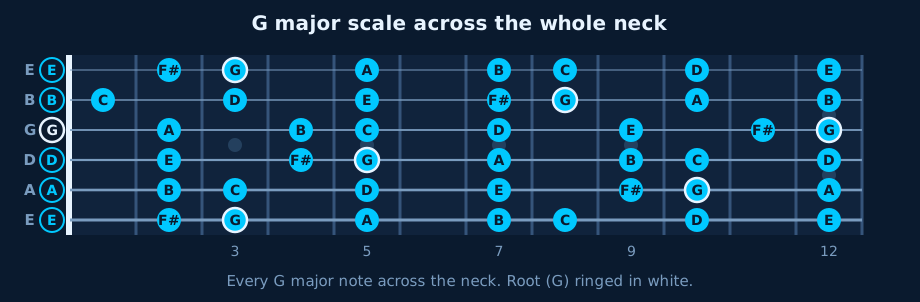
Most players learn one major scale position, get comfortable, and stop. The problem is that a single position covers only a few frets, so your playing gets stuck in one spot. The fix is to see the major scale positions as pieces of one connected pattern that runs the length of the neck, joined together by the root note. Finding that root in every position is why it pays to learn the guitar fretboard first.
Positions are windows onto one scale
There is only one G major scale: G, A, B, C, D, E, F#. A position is just one comfortable hand-shape that captures part of that scale in a few frets. The famous systems, CAGED and three notes per string, are simply different ways of slicing the same set of notes into playable shapes.
So the goal is not to memorize five unrelated boxes. It is to learn the notes once, then see how each shape hands off to the next.
Reading the map
The diagram above shows all of G major across the neck, with every G root ringed. The roots are the key. They are the landmarks that tell you where you are and connect one position to the next.
- Find the roots first. Locate every G. They anchor every shape and give you targets to resolve to.
- See the overlaps. The top of one position is the bottom of the next. There are no gaps, just one shape flowing into another.
- Watch the B string. As the pattern crosses onto the B and high E strings, it shifts up a fret, because that string pair is tuned a major third apart instead of a fourth. This is the single most common source of wrong notes when players connect positions.
A practical way to connect them
- Anchor on a root. Start from a G you know and play the position around it.
- Climb to the next root. Find the next G higher up and shift into the shape around it, learning the two or three notes that overlap between the shapes.
- Use three notes per string for flow. Placing three scale notes on each string gives an even, repeating pattern that connects positions smoothly and is great for fast, legato runs.
- Say the root as you land. Naming your landmark keeps the whole neck oriented instead of turning into a blur of shapes.
The positions finally connect when you can watch the whole scale light up and hear it played back across the neck. The Sustain Six fretboard explorer shows the major scale in every position with correct fingerings and real guitar tone, so the boxes join into one map you can actually see. It is free to try, right in your browser.