
The Pentatonic Box Guitar Players Get Stuck In, and How to Get Out
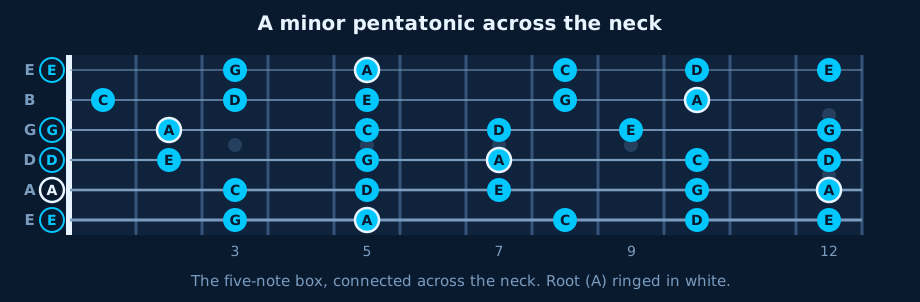
Almost every guitarist learns the same first scale: the minor pentatonic box at the fifth fret. It is a great shape and it sounds good immediately. The trouble is that most players never leave it, so every solo starts and ends in the same five frets. Breaking out is not about learning a harder scale. It is about seeing that box as one piece of a pattern that covers the whole neck. If the notes outside the box are still unnamed, learn the guitar fretboard and the rest of this gets much easier.
What the pentatonic actually is
The minor pentatonic has just five notes. In A minor that is A, C, D, E, and G. The box you already know is one fingering of those five notes. Because there are only five, they repeat all over the neck in connected shapes, and the box at the fifth fret is simply the most common starting point.
Reading the whole neck
The diagram above shows the entire A minor pentatonic across the neck, with every A root ringed.
- Your box is in there. Find the fifth-fret region and you will see the exact shape you already know, now connected to everything around it.
- Follow the roots. The ringed A notes are your landmarks. They tell you where you are in any position and give you strong notes to land on.
- The pattern repeats at the twelfth fret. Whatever you learn in the lower frets happens again above it.
- Mind the B string. As shapes cross onto the B and high E strings, they shift up a fret. This is where box-to-box connections usually go wrong.
How to get out of the box
- Start from what you know. Play your fifth-fret box and find its root notes.
- Move to the next shape. From the top of the box, find where the next notes continue higher up, and learn the overlap between the two shapes rather than treating them as separate boxes.
- Connect with the roots. Practice sliding from one root to the next along a single string, then filling in the shape around each. The roots stitch the whole neck together.
One note on method: the minor pentatonic has only five notes, so it does not fit the three-notes-per-string system that works for full scales. Pentatonics live in connected box shapes, so learn to link the boxes rather than force an even pattern onto them.
The box opens up fast when you can watch the whole scale light up and hear it across the neck. The Sustain Six fretboard explorer shows the pentatonic in every position with real guitar tone, so the one box you know grows into the entire neck. It is free to try, right in your browser.