
Guitar Interval Recognition, by Ear and on the Neck
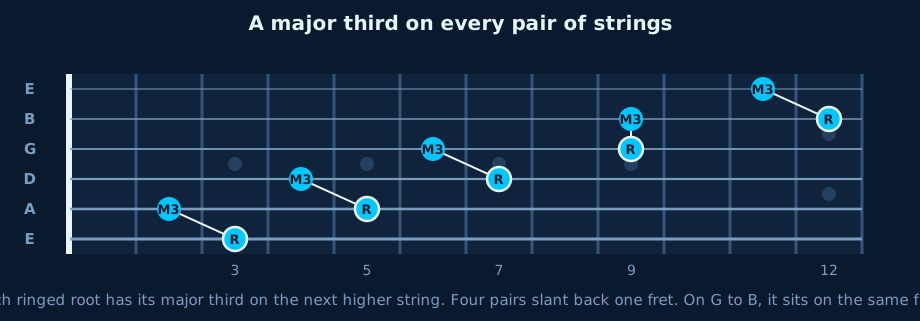
Interval names can sound like jargon, and naming one by ear can feel like guessing. Then you move an interval from the G string to the B and the shape changes for no reason you can see. You're not doing it wrong. Guitar interval recognition gets easier when you treat it as two skills that check each other: seeing the distance on the neck, and hearing it.
An interval is a distance you can count
On a single string, an interval is just a number of frets. Each fret is a half step, so the whole list fits inside one octave.
| Interval | Short name | Frets on one string | From A |
|---|---|---|---|
| Minor 2nd | m2 | 1 | Bb |
| Major 2nd | M2 | 2 | B |
| Minor 3rd | m3 | 3 | C |
| Major 3rd | M3 | 4 | C# |
| Perfect 4th | P4 | 5 | D |
| Tritone | TT | 6 | D# or Eb |
| Perfect 5th | P5 | 7 | E |
| Minor 6th | m6 | 8 | F |
| Major 6th | M6 | 9 | F# |
| Minor 7th | m7 | 10 | G |
| Major 7th | M7 | 11 | G# |
| Octave | 12 | A |
The number in a name counts letters, and the quality comes from the size. That's why three frets up from C is a minor 3rd when you call it Eb. The same fret spelled D# is written as an augmented 2nd, which sounds identical. The key you're in decides which spelling is right.
The same interval across strings
Counting frets up one string gets slow, so most intervals get played across two strings. Most neighboring strings are tuned a perfect 4th apart, five frets, so on those pairs every interval sits in a fixed spot on the next string up. A major 3rd is one fret back. A perfect 4th is on the same fret. A perfect 5th is two frets up.
There's one exception, and it's the reason those shapes seem to break. The G and B strings are tuned a major 3rd apart, four frets instead of five. So any shape that crosses from G to B moves up one fret. Start from the A on the G string at the 2nd fret. Its perfect 5th is E, and it's at the 5th fret on the B string, not the 4th.
The gap between G and B is itself a major 3rd. That's why a major 3rd across that pair sits straight up on the same fret, while on every other pair it slants back one fret. The diagram shows it on all five pairs. Octave shapes shift the same way. How to learn the guitar fretboard shows them.
Guitar interval recognition by ear
Naming an interval by ear is relative pitch. It's hearing the distance between two notes, and it gets better with short, regular practice. It won't give you perfect pitch, and how long it takes depends on you.
A familiar tune gives each interval a handle while your ear learns it. Each of these rises by that interval at the spot named:
| Interval | Tune | Where |
|---|---|---|
| Minor 2nd | Jaws theme | the first two notes |
| Major 2nd | Frere Jacques | the first two notes |
| Minor 3rd | Greensleeves | "A-las" |
| Major 3rd | When the Saints Go Marching In | "Oh when" |
| Perfect 4th | Here Comes the Bride | "Here comes" |
| Tritone | Maria (West Side Story) | "Ma-ri" |
| Perfect 5th | Twinkle Twinkle Little Star | the first "twinkle" to the second |
| Major 6th | My Bonnie Lies Over the Ocean | "My Bon" |
| Minor 7th | Somewhere (West Side Story) | "There's a" |
| Octave | Somewhere Over the Rainbow | "Some-where" |
The minor 6th and major 7th are easier learned by fret count. A major 7th is an octave one fret short. Use the tunes to get started, then drop them once you know the sound. Two notes played one after the other is also a different skill from two notes played together, so practice both.
The next step is hearing intervals inside real music, against a key. Guitar scale degrees is where that starts.
How to practice guitar interval recognition
- Play it, then sing it. Play the root and the target note, then sing both. Your voice has to find the distance, so you hear the gap more closely than you do by listening alone.
- Start with five. Minor 3rd, major 3rd, perfect 4th, perfect 5th and octave cover a lot of music. Add the rest once those feel steady.
- Name it before you look. Have a friend play two notes, or play them with your eyes shut, and say the name before you check the frets.
- Move it across the G and B strings. Play the same interval on a pair that crosses G to B and on a pair that doesn't, and feel the one-fret shift.
Hear and see every interval on the neck
Seeing and hearing an interval together fixes it faster than either one alone. On the Sustain Six fretboard, pick a root with no scale or chord selected and set Note Display to Intervals. Every note on the neck is then labeled from that root: R, m3, M3, P5 and the rest. Tap a fret to hear it. Start with A, labeled by interval, then tap the R and a nearby M3. The fretboard is free to start and needs no account. With an account, the Intervals drill in Audio mode plays two notes one after the other and asks you to name the gap.
Frequently Asked Questions
- Can you train your ear to recognize intervals?
- Yes. Recognizing intervals is relative pitch, and it gets better with short, regular practice. It doesn't give you perfect pitch, which is naming a note with no reference at all.
- Why do interval shapes change between the G and B strings?
- Every pair of neighboring strings in standard tuning is tuned a perfect fourth apart except G and B, which are a major third apart. That gap is one fret smaller, so any shape that crosses from G to B moves up one fret.
- What is a tritone?
- It's the interval of six frets, exactly half an octave. It's also called an augmented 4th or a diminished 5th, depending on how it's spelled. From C it's F# or Gb.