
Guitar Scale Degrees, and What the Numbers Under a Scale Mean
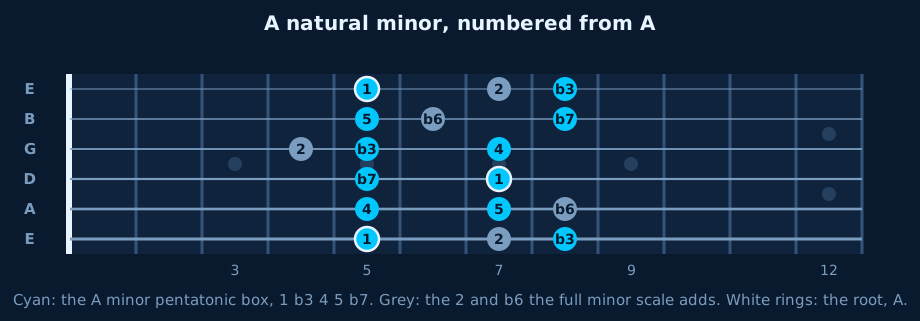
You find a scale chart, and under the dots there's a row of numbers: 1 b3 4 5 b7. That's five notes, but the numbers skip the 2 and the 6, and two of them carry a flat. If you've wondered what those numbers are counting, you're not missing anything obvious. Guitar scale degrees pack two ideas into one label, and most charts never say which part is which.
What guitar scale degrees count
A degree number has two parts, and they come from different places.
The number comes from the letter names. Count the letters up from the root. In A minor that's A B C D E F G, so C is the 3rd, F is the 6th and G is the 7th.
The flat or sharp compares the note to the major scale on the same root. A major is A B C# D E F# G#. A minor has C where A major has C#, so C is a b3. The same goes for F (b6) and G (b7). Put it together and A natural minor reads 1 2 b3 4 5 b6 b7.
A flat just says the note is lower than it would be in major. Chord formulas, scale charts and most guitar teaching all use that system. Classical theory sometimes calls C simply the 3rd degree of A minor, with no flat. It's the same note, and guitar charts use the flats.
Why a five-note box has a b3 and a b7
The minor pentatonic is the natural minor with two notes left out, the 2 and the b6. The notes that stay keep their numbers. That's why the box from the pentatonic box post reads 1 b3 4 5 b7 and not 1 2 3 4 5.
Here's how some common scales read in the same system:
| Scale | Degrees |
|---|---|
| Major | 1 2 3 4 5 6 7 |
| Natural minor | 1 2 b3 4 5 b6 b7 |
| Major pentatonic | 1 2 3 5 6 |
| Minor pentatonic | 1 b3 4 5 b7 |
| Blues | 1 b3 4 b5 5 b7 |
| Dorian | 1 2 b3 4 5 6 b7 |
| Mixolydian | 1 2 3 4 5 6 b7 |
Degrees follow the note's place in the scale, so they move with you. Slide the A minor box from the 5th fret up to the 7th and you're playing B minor. Every note changes its letter, and every number stays put.
Why the 9 is the same note as the 2
Chord names count past 7. Going up an octave adds 7 to the number, not 8, because counting starts at 1. The 2 an octave up is the 9, the 4 is the 11 and the 6 is the 13. You won't see an 8, 10 or 12 in a chord name, because those are the 1, 3 and 5 again.
One trap: as a degree, 7 means the major 7th. In a chord name, a plain "7" means the b7. C7 is C E G Bb, and Cmaj7 is C E G B. Guitar chord tones uses these same numbers to explain why some notes settle over a chord and others rub.
Degrees, Roman numerals and Nashville numbers
Three numbering systems look alike and do different jobs.
- A scale degree names one note by its place above the root: 1, b3, 5.
- A Roman numeral names a chord built on a degree, and the case shows its quality: I, ii, V7.
- A Nashville number names a chord with an Arabic number, and a bare number means major. In G, I-V-vi-IV is written 1 5 6- 4 and played G D Em C.
Chord formulas and scale degrees also count from different places. A chord formula counts from the chord's own root. In the key of C, G7 is G B D F, which is 1 3 5 b7 of G. Against C, those same notes are 5 7 2 4. Whenever a number confuses you, ask what it's counted from. How to read guitar chord progressions covers the numerals in a key.
How to learn the numbers on your own neck
- Start with the box you know. Play A minor pentatonic at the 5th fret and say each note's number as you play it.
- Find every 1 first. The roots are your landmarks. In this position there are three.
- Add the 2 and the b6. Play the full natural minor and listen to what those two notes add.
- Move it. Slide the whole thing to the 7th fret and keep saying the same numbers in B minor.
See the numbers on the fretboard
Numbers stick faster when you can see them on the neck. In Sustain Six, pick a root and a scale, then set Note Display to Degrees, and every note is labeled by its number from the root. Here's A minor with Degrees on. It's free to start, and you don't need an account.
Frequently Asked Questions
- What does b3 mean in a scale?
- It means the third note of the scale sits a half step lower than the third of the major scale on the same root. In A minor the third is C. A major has C#, so C is the b3. The flat compares the note to major. It doesn't mean the note is outside the scale.
- Why is the 9 the same note as the 2?
- Going up an octave adds 7 to a degree number, not 8, because counting starts at 1. So the 2 an octave up is the 9, the 4 is the 11 and the 6 is the 13. In C, D is both the 2 and the 9.
- Are scale degrees the same as Nashville numbers?
- No. A scale degree names one note by its place above the root. A Nashville number names a chord built on that place, and a bare number means a major chord. In G, I-V-vi-IV is written 1 5 6- 4 and played G D Em C.