
How to Read Guitar Chord Progressions Instead of Memorizing Them
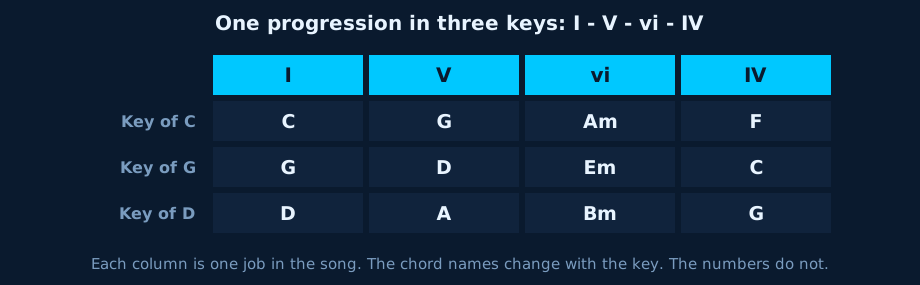
You learn a song as a string of chord names: G, C and D. The next song is C, F and G, and it feels like starting over even though the music is doing almost the same thing. That's the wall most players hit with progressions: every key looks like a new list to memorize. Learning how to read guitar chord progressions by number gets you past it, because the numbers stay the same whatever key you're in.
This is a beginner-friendly topic. If you can play a handful of open chords, you already have everything you need.
What the numbers stand for
Chord names tell you what to play. They don't tell you how the chords relate to each other, and that relationship is the part that repeats from song to song.
Every major key has seven chords built from its own scale. Number them one to seven with Roman numerals, starting on the key note. Uppercase means a major chord, lowercase means minor, and the small circle marks the one diminished chord.
| I | ii | iii | IV | V | vi | vii° | |
|---|---|---|---|---|---|---|---|
| C | C | Dm | Em | F | G | Am | B° |
| G | G | Am | Bm | C | D | Em | F#° |
So in C, V means G. In G, V means D. It's the same job in the song under a different name. If you don't know where those chords sit on the neck yet, learn the guitar fretboard alongside this.
One progression in every key
Take I-V-vi-IV, the progression behind a long list of pop songs. In C it's C, G, Am and F. In G it's G, D, Em and C. In D it's D, A, Bm and G.
Those look like three unrelated lists. Each is I, V, vi and IV: the same four jobs in the same order, with each chord the same distance above its key note in all three. Once you hear a song as I-V-vi-IV, you can play it in whatever key a singer needs, because you're moving a pattern and the names follow.
The circle of fifths guitar guide shows why those keys and chords belong together.
How to read guitar chord progressions from a chart
Most chord charts only give you names, so you do the numbering yourself. It takes about a minute a song.
- Find the key. The last chord is usually the I, and often the first one is too. A song that starts and ends on G is probably in G.
- Number every chord. Count up the key's seven chords from the I. In G, C is the fourth chord, so it's IV. Em is the sixth, so it's vi.
- Look for a pattern you know. A run that reads I-V-vi-IV or I-IV-V is a progression you've already played in some other song.
- Play it in a second key. Move the whole thing from G to D or A. When the numbers still make sense to your ear, the progression is yours in every key.
Four progressions worth recognizing
- I-IV-V. C, F and G in C, or G, C and D in G. It sits under a lot of rock and folk.
- I-V-vi-IV. C, G, Am and F in C. This is the four-chord pop progression.
- ii-V-I. Dm, G and C in C. Jazz leans on this move, usually as Dm7, G7 and Cmaj7.
- The 12-bar blues. In C, bars one to four are C7. Bars five and six are F7, and bars seven and eight go back to C7. The last four bars run G7, F7, C7 and G7. These are dominant seventh chords, and only the V7 belongs to the key. The blues borrows the other two on purpose, which is a big part of its sound.
See the numbers stay put
Numbers click fastest when you can see one progression under two sets of chord names. In the Sustain Six progressions library, every progression shows its key, its Roman numerals and its chord names together. The Pop Anthem and Country Two-Step cards both read I - V - vi - IV. Pop Anthem spells it C, G, Am and F. Country Two-Step spells it D, A, Bm and G. The Builder tab also takes a progression typed as numbers, like I IV V I, and turns it into chords you can play. The app's Progressions mode is free to start, no account needed, and signing in keeps the progressions you build.
Frequently Asked Questions
- What do the Roman numerals in a chord progression mean?
- Each numeral is the chord's position in the key, counted up from the key note. Uppercase is a major chord, lowercase is minor, and a small circle marks the one diminished chord. A flat sign in front, like bVII, means the chord's root sits a half step below that step of the major scale.
- How do I work out what key a song is in?
- Start with the last chord. It's usually the I. The first chord often is too. Then check that most of the other chords belong to that key's seven chords.
- Do blues progressions follow the same numbers?
- The numbers work the same way, but the 12-bar blues uses dominant seventh chords on the I, IV and V, and only the V7 belongs to the key. The other two are borrowed on purpose.