
How to Play Barre Chords on Guitar, and Why F Is the Hard One
You can play E, A and the rest of the open chords, and then a song asks for F. Strings buzz, one note goes dead, and your hand aches after a minute. That's normal. Nothing is wrong with your hands. F is the barre chord most players meet first. To learn how to play barre chords, start with what your index finger actually has to do.
A Barre Chord Is an Open Chord With Your Finger as the Nut
F major is the open E chord moved up one fret. In E, three strings ring open: the low E, the B and the high E. Move the shape up a fret and those strings need something to press them, so your index lies across the neck at fret 1 and does the job the nut used to do.
That's why you re-finger the E shape before you move it. Play E with your middle, ring and pinky instead of your index, middle and ring, and your index is free to become the new nut.
| Open chord | Frets | Barre chord | Frets | Index sounds |
|---|---|---|---|---|
| E | 0 2 2 1 0 0 | F | 1 3 3 2 1 1 | low E · B · high E |
| Em | 0 2 2 0 0 0 | Am | 5 7 7 5 5 5 | low E · G · B · high E |
| A | x 0 2 2 2 0 | B | x 2 4 4 4 2 | A · high E |
| Am | x 0 2 2 1 0 | Bm | x 2 4 4 3 2 | A · high E |
Your Index Only Sounds Three Strings in F
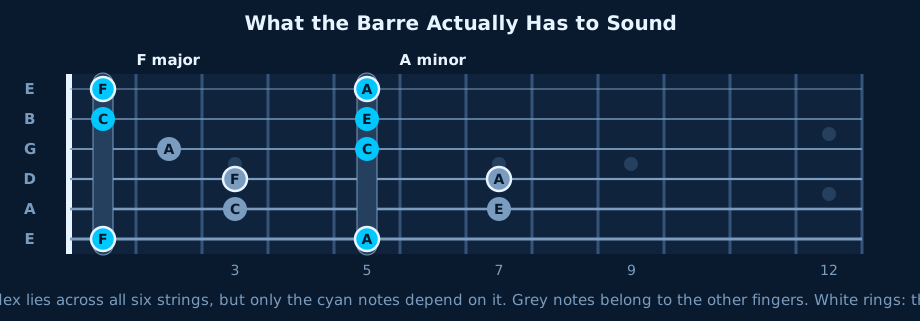
Your index lies across all six strings in an F barre, but only three of them depend on it. Your other fingers fret the A, D and G strings higher up, and the higher fret is the one that sets the pitch. So for the index, only the low E, the B and the high E matter. If the A, D or G string buzzes, check the finger fretting it.
The minor E-shape barre asks a little more. In A minor at fret 5, the G string is under the index too, and it often lands in a joint crease.
Why F Is the Hard One
F is usually the first barre you meet, because it's the IV chord in C and shows up early in songs built on C, F, G and Am. Reading chord progressions shows where it sits. It also lands in an awkward spot on the neck. Frets 1 to 3 are the widest stretch, and a string pressed just past the nut takes more force to push down than one pressed higher up. If the nut on your guitar is cut high, that makes it worse, and a guitar tech can check it.
How to Play Barre Chords Without Fighting Them
- Start higher up the neck. Learn the shape at fret 5, as A major (5 7 7 6 5 5), where the frets are narrower and the strings are easier to press. Then walk it down a fret at a time until it's F at fret 1.
- Put the index just behind the fret wire. On top of the wire it buzzes, and in the middle of the fret it takes more pressure. Rolling it slightly onto its thumb-side edge often moves a crease off a string.
- Pull back with your arm. Many players find that clamping with the thumb tires the hand fast. A gentle pull from the arm does more of the work.
- Pick one string at a time. Find the string that buzzes or goes dead. If the index holds it, adjust the index; if not, check the finger fretting it.
Move One Shape, Get a New Chord
Once a barre shape works, the root string names the chord. In the E shape the root is on the low E string, so the same shape is F at fret 1, G at fret 3, A at fret 5 and C at fret 8. In the A shape the root is on the A string, so it's B at fret 2, C at fret 3 and D at fret 5. Don't play the low E in the A shape. Either skip it or let the tip of your index touch it so it stays quiet.
Between them, the E and A shapes, major and minor, can play every major and minor chord somewhere below the 13th fret. How to learn the guitar fretboard shows the notes on those two strings, and the CAGED system shows how the other open shapes become barres too.
See Where the Barre Sits
It helps to see which strings the barre covers before your hand has to find them. In the Chord Library, tap F under Root Note and the cards show a bar for the barre, a finger number on every dot and the note under each string you play. It also shows a four-string F that skips the low strings, which is a fine stepping stone while the full barre comes along. The Chord Library is part of Sustain Six, which is free to start and needs no account.
Frequently Asked Questions
- Why does my F barre chord buzz?
- Often it's a string your index has to sound that isn't pressed cleanly, because it sits in a joint crease or too far from the fret. Pick each string on its own to find it. If the index holds it, move the index closer to the fret or roll it slightly onto its thumb-side edge; if not, check the finger fretting it.
- Does my index finger have to press all six strings?
- No. In the F barre it only has to sound the low E, B and high E strings. Your other fingers fret the rest higher up, and the higher fret sets the pitch.
- What's the difference between an E-shape and an A-shape barre?
- An E-shape barre is the open E chord moved up the neck, with its root on the low E string. An A-shape barre is the open A chord moved up, with its root on the A string and the low E not played.