
Which Open Chords for Guitar to Learn First
A chord chart can show you thirty boxes at once. A songbook can throw five chords at you on the first page. The Xs and Os over the strings don't tell you where to start. You don't need all of them yet. Open chords for guitar come in a small first set, and the order you learn them in gets you to songs sooner.
What makes a chord open
An open chord is a shape near the nut where at least one string rings with no finger on it, and that open string is part of the chord. That's the whole definition. It says nothing about how hard the shape is, and plenty of open chords exist beyond the ones below.
The eight open chords for guitar most players start with
These are the usual first set: five major chords and three minor ones. Strings are listed from the low E to the high E, and x means the string isn't played.
| Chord | Frets | Notes, low to high | Not played |
|---|---|---|---|
| G | 3 2 0 0 0 3 | G B D G B G | none |
| C | x 3 2 0 1 0 | C E G C E | low E |
| D | x x 0 2 3 2 | D A D F# | low E and A |
| E | 0 2 2 1 0 0 | E B E G# B E | none |
| A | x 0 2 2 2 0 | A E A C# E | low E |
| Em | 0 2 2 0 0 0 | E B E G B E | none |
| Am | x 0 2 2 1 0 | A E A C E | low E |
| Dm | x x 0 2 3 1 | D A D F | low E and A |
G is also often played with a different fingering on the same frets, so use whichever your hand settles into. If chord boxes are still new, how to read a fretboard diagram walks through the Xs, Os and finger numbers.
Why some strings get an X
It's tempting to think an X marks a wrong note. Usually it doesn't. In all eight of these chords, the lowest note you play is the root, and the Xs are there to keep it that way.
On C, the open low E is an E, which is in the chord. Played, it would put the chord's 3rd underneath instead of the C. On A and Am, the open low E is the 5th, so it's in the chord too, but played it would sit under the root. D and Dm are the one case where a skipped string really is outside the chord. The open A is the 5th, so it belongs, but the open low E isn't in D or D minor at all.
The order to learn them in
Switching between chords is the real work at this stage, so learn them in groups that show up in the same songs.
- Start with G, C and D. They're the I, IV and V in the key of G, and reading chord progressions shows why those three carry so many songs. Em fits in here too, since G D Em C is the I-V-vi-IV progression behind a long list of pop songs, and Em needs only two fingers.
- Add E and A. That completes the five major shapes, and A, D and E give you the I, IV and V in A.
- Learn Am and Dm last. Like Em, each is a major chord you already know with one note moved down a fret.
- Practice the changes. Once two chords feel steady, switch between them slowly and in time. The shapes stick faster when they're moving.
One note turns major into minor
The note that changes is the chord's 3rd, and guitar chord tones explains why that one note decides the sound.
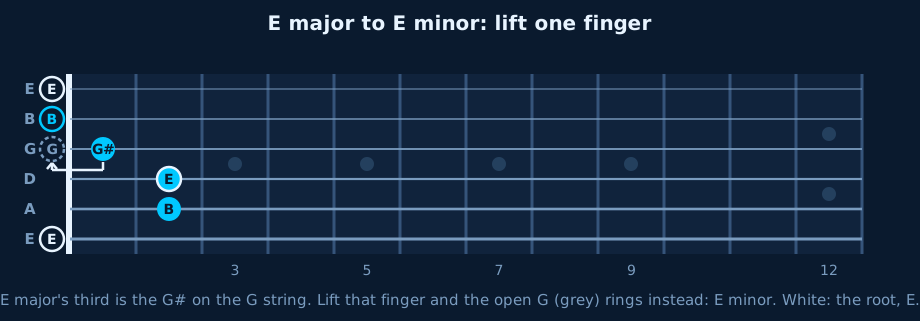
From E to Em, you lift the finger on the G string, so the G# becomes an open G. From A to Am, the C# on the B string at fret 2 drops to C at fret 1. From D to Dm, the F# on the high E at fret 2 drops to F at fret 1. On A and D your fingers rearrange a little, but it's still just one note.
Look at the key of C. Its major and minor chords are all open shapes except one, F. F needs a barre, and that's usually the next wall.
See every shape before you play it
A shape is easier to remember when you can see what each finger is holding. In the Chord Explorer, tap a root under Root Note and choose Major or Minor. The open shape comes first. Each dot carries a finger number, and every string you play shows its note, with the root in blue. An O or an X marks the open and unplayed strings. The Chord Explorer is part of Sustain Six, which is free to start and needs no account.
Frequently Asked Questions
- What is an open chord on guitar?
- It's a chord shape near the nut where at least one string rings with no finger on it, and that open string is a note of the chord. G, C, D, E, A, Em, Am and Dm are the usual first set.
- Which open chords should I learn first?
- G, C and D first, because they're the I, IV and V in the key of G and make songs right away. Then E and A. Then Em, Am and Dm, which are each a major chord with one note lowered.
- Why do some chord charts put an X over a string?
- An X means you don't play that string. In C, D, A, Am and Dm it keeps the root as the lowest note. On D and D minor, the open low E would also add a note that isn't in the chord.