
Standard Guitar Tuning, and the One Gap That Breaks the Pattern
Chord charts, tabs and lessons assume your guitar is in standard tuning unless they say otherwise. You might know the letters E A D G B E and still not be sure which E is which, or why a tuner shows E2 on one string and E4 on another. That's worth sorting out once, because standard guitar tuning is the map every shape you learn is drawn on.
The Six Notes of Standard Guitar Tuning
From the thickest string to the thinnest:
| String | Name | Pitch | About |
|---|---|---|---|
| 6 | Low E | E2 | 82.4 Hz |
| 5 | A | A2 | 110 Hz |
| 4 | D | D3 | 146.8 Hz |
| 3 | G | G3 | 196 Hz |
| 2 | B | B3 | 246.9 Hz |
| 1 | High E | E4 | 329.6 Hz |
Those frequencies are rounded, and they assume the usual reference of A = 440 Hz.
Why the Low E Is the Top String
It feels backward that the low E is the top string as you look down at the guitar. It's the thickest string, and it's called low because it has the lowest pitch. The thin high E is closest to the floor.
String numbers start at the thin end. String 1 is the high E and string 6 is the low E. Fretboard diagrams usually draw the high E on top, which is why reading a fretboard diagram can trip you up at first.
What the Numbers After the Letters Mean
The number after each letter is its octave. It counts up by one at every C, and middle C is C4. So the B string is B3, and one fret up on that string you reach C4, which is middle C.
That's how you can tell the two E strings apart. The high E, E4, is the E just above middle C. The low E, E2, is two whole octaves below it. The A string makes a handy check. It's 110 Hz, two octaves below the 440 Hz A you'll find at the 5th fret of the high E string.
The One Gap That Breaks the Pattern
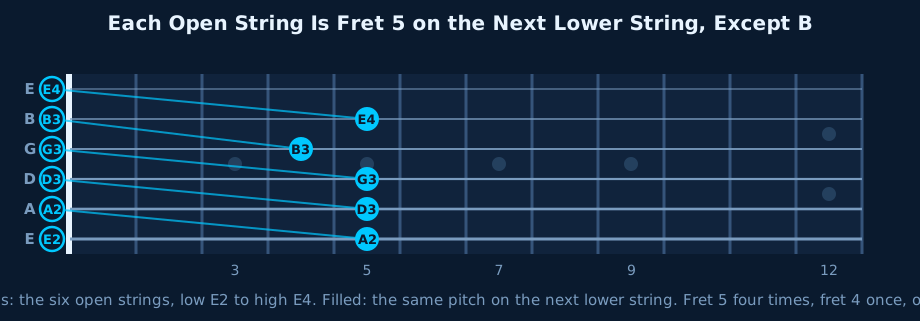
Count the frets between neighboring strings and you'll see a pattern. Low E to A, A to D and D to G are each a perfect 4th apart, five frets. B to high E is a perfect 4th as well. G to B is the odd one out. It's a major 3rd, four frets.
You can see it on the neck. Fret 5 on the low E, A, D and B strings gives the same pitch as the next thinner string played open. On the G string you need fret 4 to match the open B. If every gap were a 4th, the thin high string would be F, not E.
That single gap is why so many shapes shift by a fret when they cross onto the B string. To see how the gap changes the shapes, read guitar interval recognition. To see which notes sit on each string, read how to learn the guitar fretboard.
How to Learn the Six Open Strings
- Say them low to high. "Eddie Ate Dynamite, Good Bye Eddie" gives you E A D G B E, from the thickest string to the thinnest.
- Learn them by number too. String 1 is the high E and string 6 is the low E, and lessons use both.
- Hear each one. Once your guitar is in tune, play the open strings from thickest to thinnest and say each name as it sounds.
- Check the top of any tab. If it names a different tuning, some or all of its frets will give different notes in standard tuning.
Hear Each String on the Tuner
It's easier to remember a pitch you've actually heard. The tuner in Sustain Six opens on Standard, E A D G B E. Pick a string first and press Play Reference Tone to hear it at its real octave. Then tap the microphone and play that string, and the tuner shows the note, its octave and how far off you are. It's free to start, and you don't need an account.
Frequently Asked Questions
- What are the notes of standard guitar tuning?
- From the thickest string to the thinnest: E, A, D, G, B, E. With octave numbers that's E2, A2, D3, G3, B3 and E4.
- Which string is the low E?
- The thickest string, the one nearest your face as you hold the guitar. It's called low because it has the lowest pitch. It's also string 6, and the thin high E is string 1.
- Is the B string tuned differently from the others?
- The B string itself is an ordinary B3. What's different is its gap from the G string: every pair of neighboring strings is a perfect 4th apart, five frets, except G to B, which is a major 3rd, four frets.